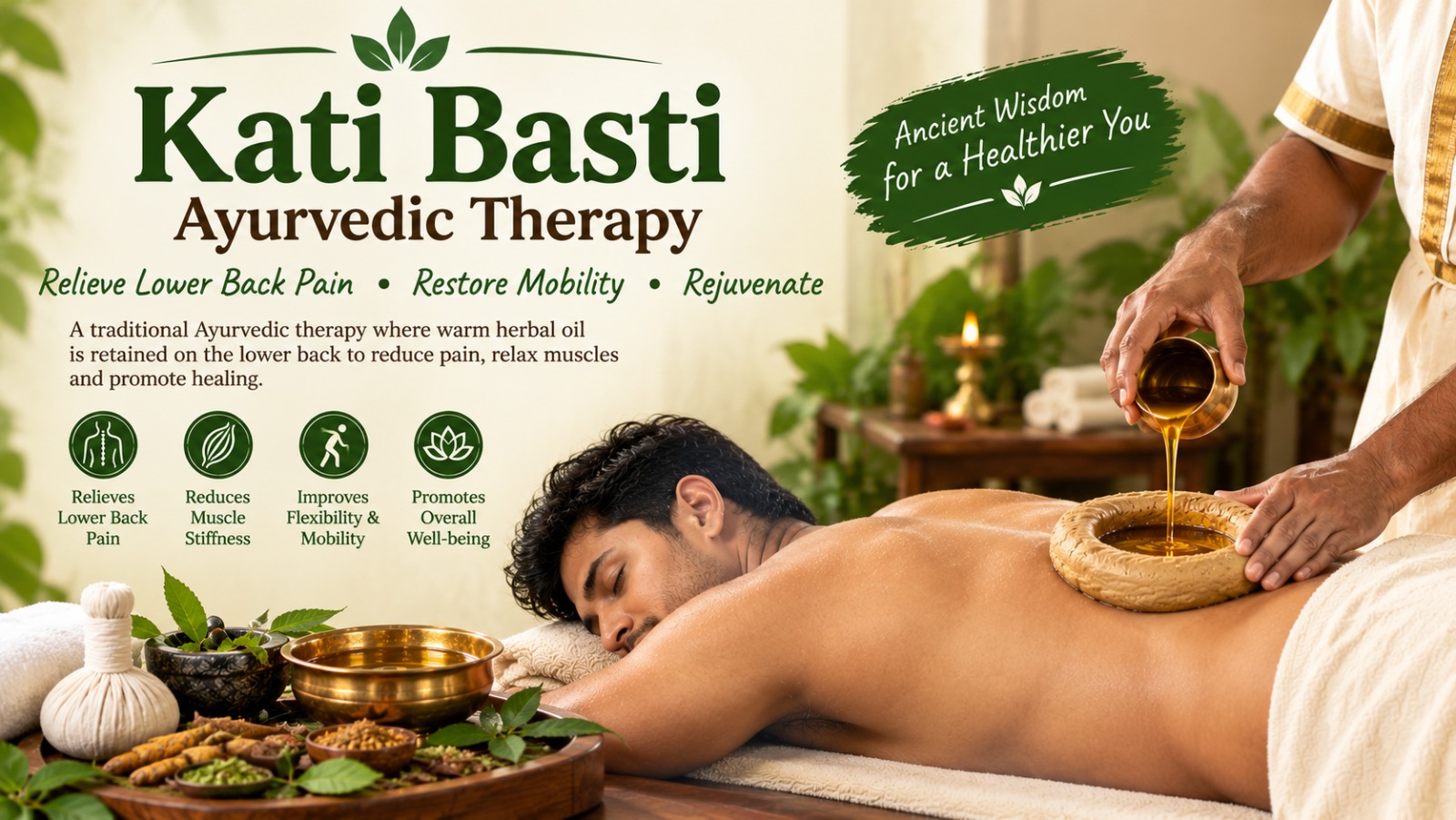
Kati Basti (also written Kati Vasti) is an Ayurvedic therapy in which warm medicated oil is held over the lower back inside a ring of dough. It is used mainly for chronic low back pain and stiffness, and is classed as a Vata-calming, snehana (oiling) and swedana (warming) treatment.
Kati means waist or lower back, and basti means to hold or retain. The name describes the method: oil is retained over the lumbar region rather than simply rubbed in. It belongs to the family of bahya basti (external retention) therapies, alongside Greeva Basti for the neck, Janu Basti for the knee and Hrid Basti for the chest. It is commonly offered as part of Panchakarma-style care and Kerala-style Ayurvedic treatment.
**Essence:**In Ayurveda, the lower back is a main seat of Vata, which is dry, cold, light and mobile. Pain, stiffness and cracking in the spine are read as signs of aggravated Vata, often with weakened muscle and bone tissue. Warm, heavy, unctuous oil is the classical opposite of these qualities. Holding it in place gives the warmth and oil time to soothe the muscles, ligaments and spinal region, rather than passing quickly over the skin.
Oils Commonly Used The oil is chosen by the practitioner according to the condition and constitution. • Sesame oil (tila taila): the plain, traditional base • Bala taila: used for nerve and muscle weakness • Dhanwantharam taila: a classical Vata-pacifying oil • Mahanarayana taila: used for joint stiffness and muscle pain •Sahacharadi taila: often used for back and sciatic-type pain
It Is Traditionally Used For
• Chronic low back pain and stiffness • Lumbar spondylosis and degenerative changes • Sciatica (gridhrasi) and radiating leg pain • Muscle spasm and strain from posture or heavy work • Pain linked to disc problems, as a supportive measure
These uses come from classical principles and clinical practice. Studies of Kati Basti for chronic low back pain have reported pain relief.Kati Basti applies a simple idea: keep warm oil in contact with the lower back long enough to ease Vata-related stiffness and pain. Done by a trained practitioner and combined with sound posture, movement and medical care where needed, it is a well-established part of Ayurvedic back care.
This article is for general educational purposes and is not a substitute for personal medical advice. Consult a qualified Ayurvedic practitioner or physician before starting any therapy, especially if you have a health condition.